George Dance the Younger’s porch at the Guildhall
The Guildhall is the seat of the Corporation of the City of London, the organisation responsible for the governance and management of the City, or the Square Mile, as it’s sometimes known. The building dates from the 1400s, but it’s been repaired and rebuilt numerous times since it was first built. Although it survived the Great Fire of London in 1666, it was damaged by fire on other occasions, and was severely damaged by bombing during the Second World War.
However, all that need not concern us right now. The picture below shoes the most striking feature of the Guildhall when viewed from outside in Guildhall Yard: the pale Portland stone entrance porch. The earlier 17th century entrance to the Guildhall had been damaged in a fire in an adjacent building. The architect George Dance the Younger (1741 -1825), was asked to salvage it, but this proved impractical, so he designed a new entrance porch, which was built in 1788 - 1790.
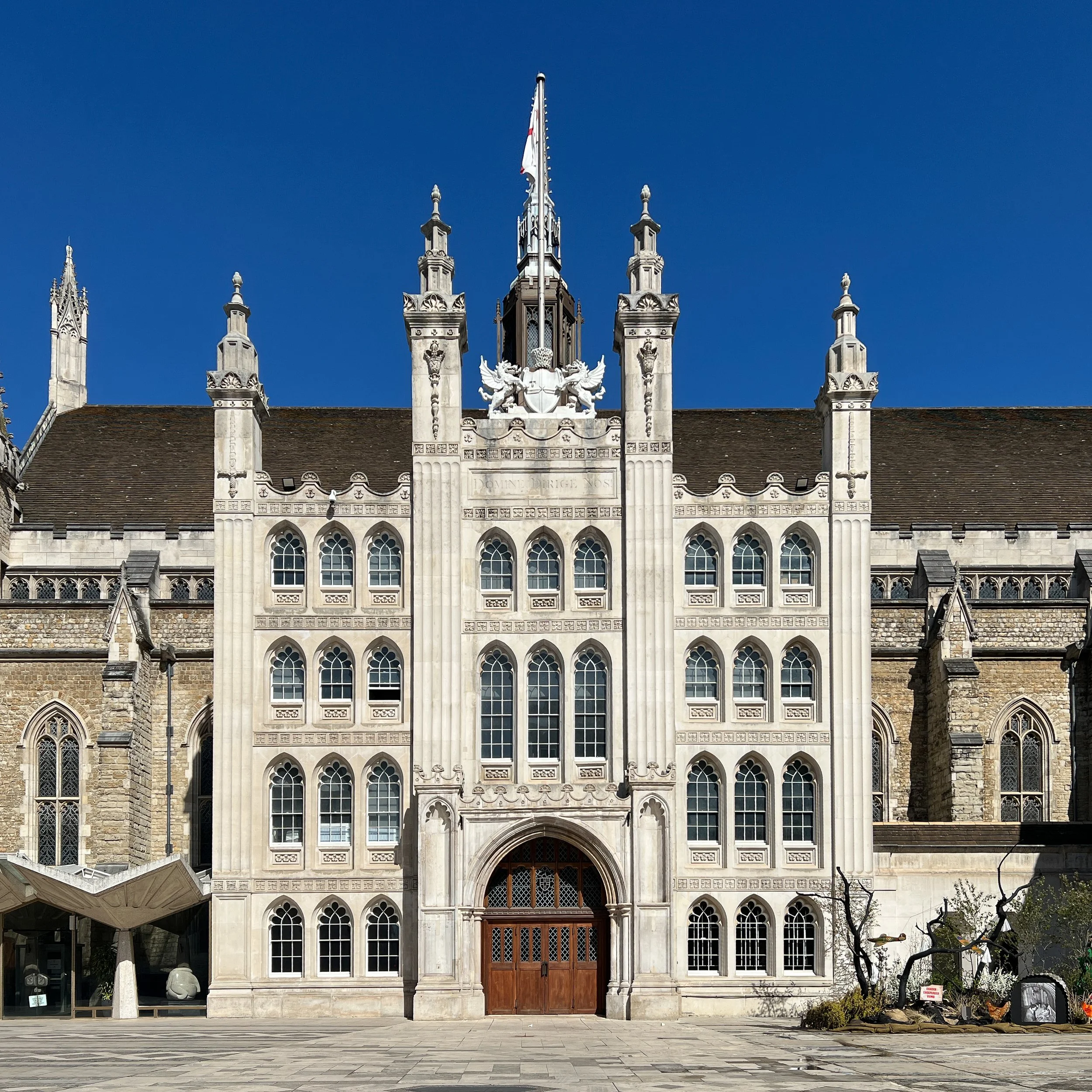
The porch of the London Guildhall. George Dance the Younger. (My photograph)
With its pointed windows and its pinnacles, the initial impression is perhaps of a gothic building, but if you look more closely, and perhaps compare it with the darker 14th century one behind, you might start to notice some differences. The scalloped glass panes aren’t typically gothic, nor are the pinnacles, or the turrets along the roof line.
In this building, we see for the first time first time the use of elements from Indian architecture in a British building. The source of the architect’s inspiration can be found in the work of his friend, the artist William Hodges, who lived and travelled in India between 1780 and 1783. On returning to England, he and published a series of 48 aquatints of Select Views of India. Some of Dance’s contemporaries certainly made the connection between Hodges’ prints and Dance’s work. The architect James Wyatt said it had “something taken from the prints published by the artist Hodges”.
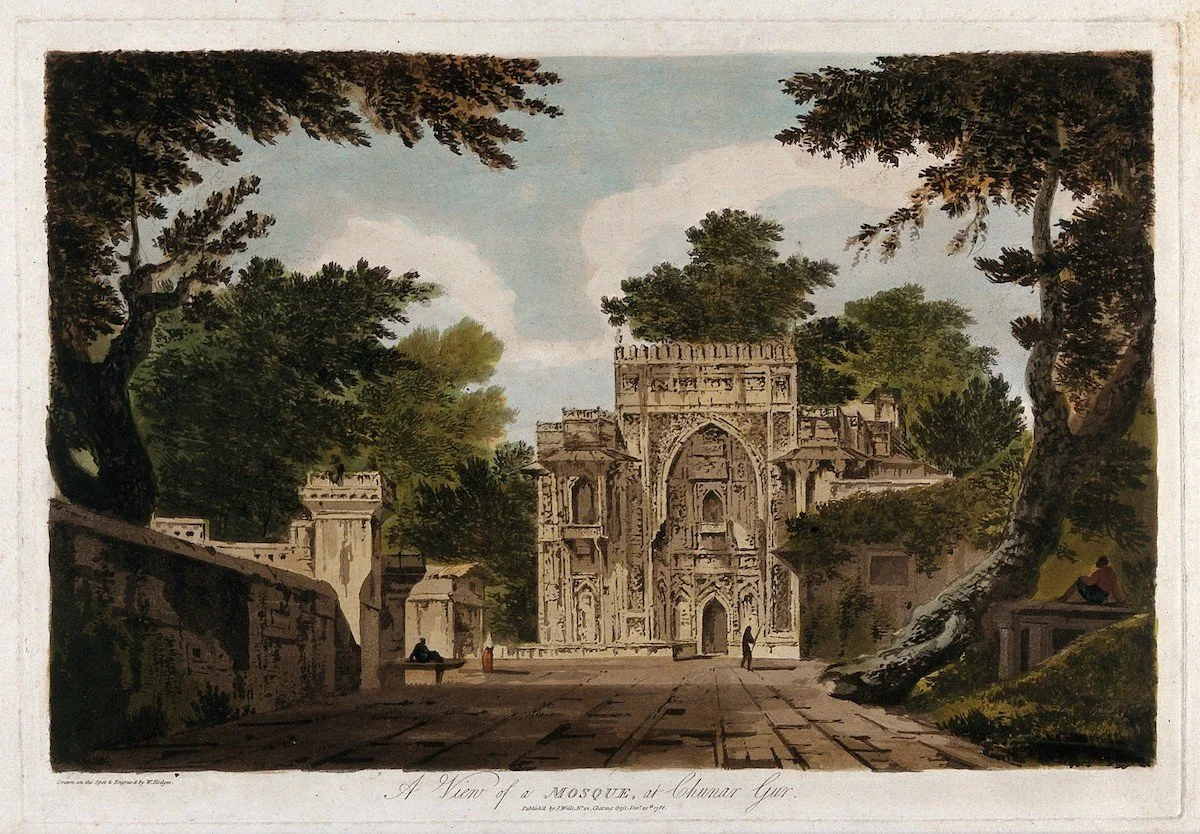
William Hodges, A View of a Mosque at Chunar Gur, 1786. Aquatint with hand-coloring, 32.7 x 47.8 cm. Plate 19 of Selected Views in India, Drawn on the Spot, in the Years 1780, 1781, 1782, and 1783, and Executed in Aquatinta (London: J. Edwards, 1786-1788). The Wellcome Collection. Image in the Public Domain.
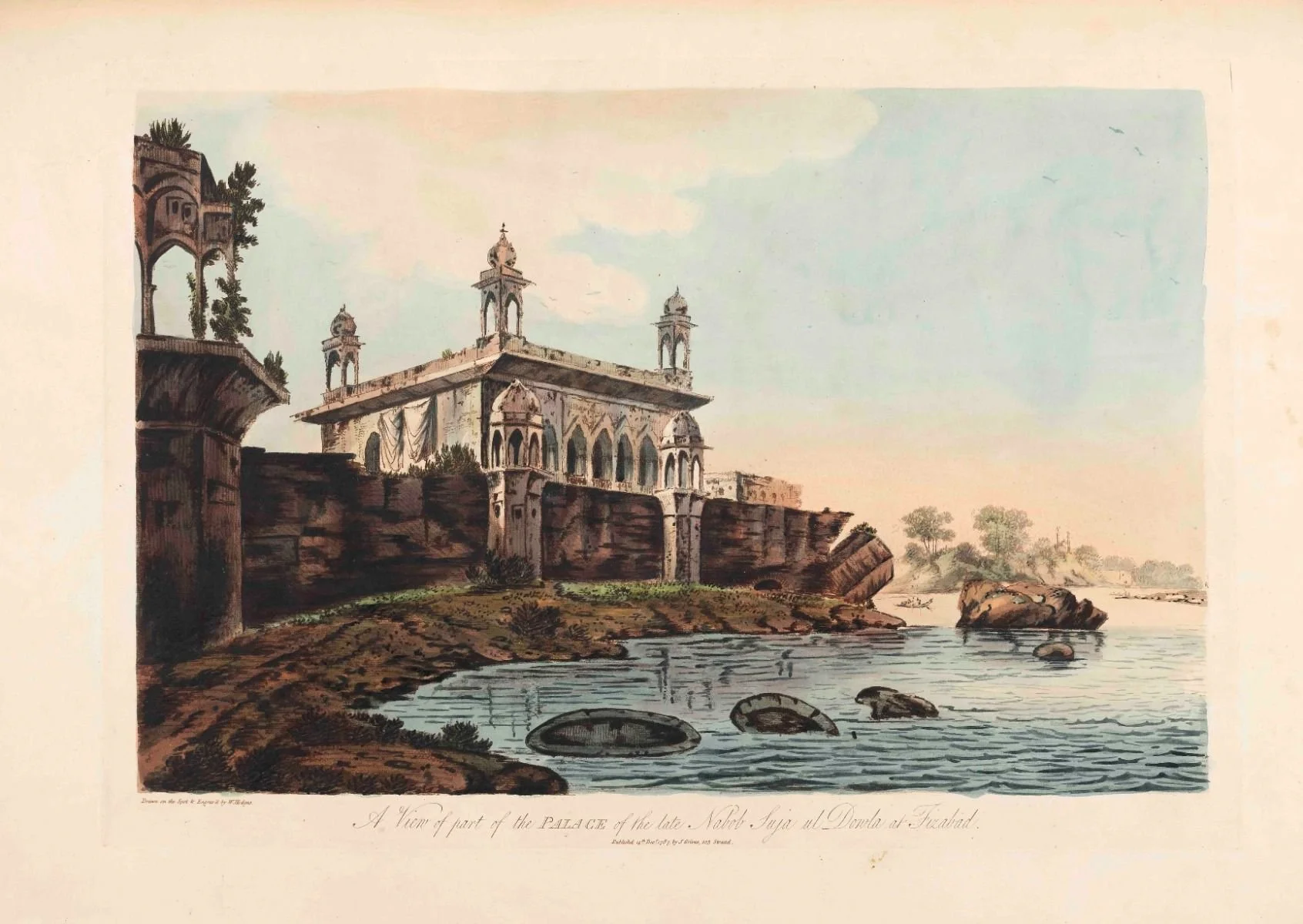
William Hodges, A View of Part of the Palace of the Late Nabob Suja ul Dowla at Fizabad,1787, 12.5 x 18.5 in https://dagworld.com/a-view-of-part-of-the-palace-of-the-late-nabob-suja-ul-dowla-at-fizabad.html
This fusion of European architecture in a style that has been sometimes called “Hindoo Gothic” or “Indo-Saracenic” was not widely adopted in Britain, but was used quite extensively in British India, as you might imagine, and elsewhere in the Empire, for example in the Kuala Lumpur Railway station in Malaysia.

Kuala Lumpur Railway Station. Arthur Benison Hubback, 1910. Source: Wikipedia
At the Guildhall, however, apart from being a chance for the architect to engage in a flight of fancy, there may have been a two-fold symbolism. The gothic style was, at the time, thought to symbolise the traditional freedoms and liberty which the City of London had enjoyed since the middle ages, while India was a the place where huge fortunes could be made, contributing to the prosperity of the City and the Nation.
References:
Zirwat Chowdhury, “George Dance the Younger Sets Guildhall Alight,” Journal18 Issue 11 The Architectural Reference (Spring 2021), https://www.journal18.org/5665.
Gillian Darley, “The architect who startled Georgian London”, Apollo (January 2025) https://apollo-magazine.com/george-dance-younger-architect-georgian-london/
“William Hodges & the Prospect of India”, exhibition at DAG, New Delhi (22 December 2023 - 25 January 2024) https://dagworld.com/william-hodges-the-prospect-of-india.html